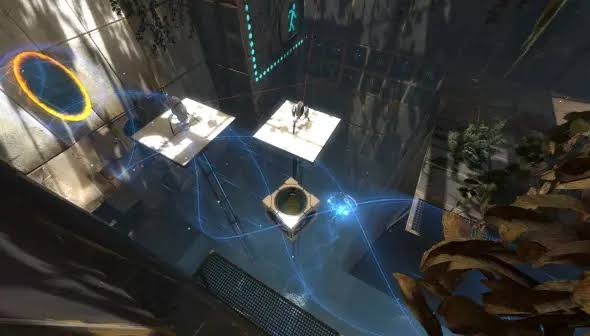
Portal is a paid first-person puzzle game from Valve, priced at around $9.99 USD on Steam (frequently discounted to just a dollar or two during major sales, and occasionally given away entirely free during select promotions). There’s no guaranteed free full download outside of these promotions — this guide covers the legitimate install steps, requirements, and an honest look at why this short, clever puzzle game became one of the most influential titles in gaming history before you buy, and why its reputation has only grown stronger in the years since its original 2007 release.
What Is Portal?
Portal casts players as Chell, a silent test subject navigating a series of increasingly complex puzzle chambers within the Aperture Science facility, guided — and frequently mocked — by GLaDOS, an artificial intelligence whose calm, deadpan narration gradually reveals itself as one of gaming’s most memorable antagonists. The game’s central mechanic, the Aperture Science Handheld Portal Device, lets players create two linked portals on flat surfaces, allowing instantaneous travel between them and enabling physics-based puzzle solutions built around momentum, timing, and spatial reasoning unlike anything else in gaming at the time of its 2007 release.
Despite its relatively short length, Portal’s tight puzzle design, sharp comedic writing, and GLaDOS’s now-iconic dark humor made it an immediate critical and cultural phenomenon, spawning countless internet memes, a beloved closing song, and a legacy that established Valve’s Aperture Science universe as one of gaming’s most fondly remembered settings. Originally bundled as part of The Orange Box alongside Half-Life 2 and Team Fortress 2, Portal has since been sold as a standalone title, making it accessible to players who want the puzzle experience without the additional bundled games.
How to Download Portal (Official Steps)
- Open Steam and search for “Portal”.
- Confirm the listing is published by Valve.
- Click Add to Cart and complete checkout (or claim it for free during an active promotional giveaway if one is running).
- Let Steam finish downloading and installing the files (it’s a very small download by modern standards).
- Launch the game, and start working through the test chambers — the cake is, famously, a lie.
Puzzle Design and GLaDOS’s Legacy
Portal’s puzzle chambers are structured as a carefully paced tutorial that gradually introduces new mechanical concepts — momentum preservation through portals, using turrets and hazards as environmental obstacles, and eventually combining multiple systems together — without ever explicitly over-explaining its rules to the player. This deliberate, almost invisible teaching structure is frequently cited in game design education as a masterclass in how to introduce mechanical complexity gradually while keeping players engaged and challenged rather than overwhelmed or bored.
GLaDOS, voiced by Ellen McLain, became an instant fan-favorite character specifically because of how her tone shifts across the game — beginning as a seemingly helpful, if oddly stilted, guide before gradually revealing a darker, more manipulative personality as the story progresses toward its now-legendary confrontation. Her closing musical number, “Still Alive,” became a genuine cultural phenomenon in its own right, frequently covered, referenced, and parodied across gaming culture well beyond the game’s original audience.
Portal’s success directly led to Portal 2, a significantly longer, more elaborate sequel expanding the story, mechanics, and cast, but the original remains beloved specifically for its tight, focused scope — a relatively short, three-to-four-hour experience with almost no wasted content, standing in contrast to many modern games’ tendency toward much longer runtimes.
Key Features
- The signature portal-based physics puzzle mechanic that defined an entire subgenre.
- A tightly paced, expertly structured tutorial-through-gameplay puzzle progression.
- GLaDOS, one of gaming’s most memorable and quotable antagonists.
- A short, focused three-to-four-hour campaign with minimal padding.
- The iconic closing song “Still Alive,” a genuine cultural phenomenon.
- A foundational entry in Valve’s beloved Half-Life and Aperture Science universe.
Ways to Get It for Less (or Free)
- Steam sales: Portal frequently drops to a dollar or two during major Steam sale events.
- Free promotional giveaways: Valve has occasionally given Portal away entirely free during special promotions — watch for these events.
- The Orange Box: Buying the original Orange Box bundle, where still available, includes Portal alongside Half-Life 2 and Team Fortress 2.
System Requirements for Portal
| Component | Minimum | Recommended |
|---|---|---|
| OS | Windows 7/8/10 | Windows 10/11 (64-bit) |
| CPU | 1.7 GHz processor | Any modern dual-core or better |
| RAM | 512 MB | 2 GB or more |
| GPU | DirectX 8-level graphics card | Any modern integrated or dedicated GPU |
| Storage | ~4 GB free space | 4 GB free space |
Pros and Cons of Portal
✅ Pros
- Genuinely inventive, influential puzzle mechanics still fresh decades later
- Sharp, memorable writing and one of gaming’s best antagonists
- Extremely lightweight, running on virtually any modern PC
- Tight, focused length with almost no filler content
❌ Cons
- Very short campaign, especially for players wanting a longer experience
- No multiplayer or co-op modes in the original game
- Limited replay value once puzzles are solved
- Portal 2 offers significantly more content for a similar or lower price during sales
Availability by Platform
🖥️ PC (Windows/Mac/Linux)
Available on Steam as a one-time purchase.
🎮 Consoles
Also available historically on PlayStation 3 and Xbox 360 through The Orange Box bundle.
🕹️ Related Title
Portal 2 is a significantly longer, more elaborate sequel sold separately.
Tips for New Players
- Take your time with early test chambers to fully understand momentum and portal placement fundamentals.
- Watch for environmental hints and companion cube attachments as puzzle-solving tools.
- Don’t skip GLaDOS’s dialogue — much of the game’s charm comes from her evolving commentary.
- Stick around after the credits for the closing song, a genuine gaming culture highlight.
- Consider Portal 2 afterward if you want significantly more puzzle content in a similar style.
Who Should — and Shouldn’t — Play Portal
Portal’s Cultural Footprint Beyond Gaming
Few games of Portal’s relatively modest length and scope have left as lasting a cultural footprint, with references to the game appearing across unrelated media, academic discussions of game design, and even real-world physics education contexts where instructors have used the portal mechanic as an accessible way to introduce concepts like momentum conservation. GLaDOS herself has become something of a shorthand cultural reference for a specific kind of dry, menacing AI antagonist, cited frequently in broader discussions about fictional artificial intelligence long after the game’s initial release.
This outsized cultural impact relative to Portal’s short runtime is frequently used as a counterexample to the assumption that longer games necessarily leave a bigger mark, demonstrating that tight, focused design executed exceptionally well can achieve a level of lasting recognition that many much longer, more expensive productions never reach.
The Aperture Science Universe Explored Further
Beyond the core narrative, Portal’s environmental storytelling — hidden observation rooms, unsettling background details, and scattered clues about Aperture Science’s troubled history — rewards attentive players willing to look beyond the immediate puzzle-solving objective in front of them. This layer of optional environmental detail, expanded significantly in Portal 2, established a foundation for exploring Aperture Science’s dark corporate history that has become a beloved part of the wider franchise’s appeal among dedicated fans.
Speedrunning and the Competitive Community
Despite its short official runtime, Portal developed a genuinely dedicated speedrunning community exploiting subtle physics quirks and portal placement techniques to complete the game in a fraction of its intended playtime, with some advanced techniques allowing players to sequence-break entire sections through creative momentum exploitation. This speedrunning scene remains active today, continuing to discover new techniques even years after the game’s original release, demonstrating a depth of mechanical possibility that casual players rarely encounter during a normal playthrough.
Music, Sound Design, and Voice Direction
Portal’s minimalist ambient soundtrack, largely composed by Kelly Bay and Mike Morasky, reinforces the sterile, unsettling atmosphere of Aperture Science’s test chambers without ever becoming intrusive during actual puzzle-solving sections, saving its more memorable musical moments for key narrative beats and the now-iconic closing credits song. This restraint in audio design mirrors the game’s broader minimalist philosophy — nothing exists in Portal purely for spectacle, with every design element, from music cues to environmental details, serving a specific narrative or gameplay purpose rather than existing as decoration.
Ellen McLain’s voice performance as GLaDOS similarly benefits from careful direction that gradually shifts tone across the game’s relatively short runtime, moving from calm, clinical instruction to something considerably more sinister as Chell — and the player — begin to understand the true nature of the testing they’ve been subjected to, all without a single piece of visible on-screen dialogue text needed to convey character development.
Final Thoughts
Nearly two decades after release, Portal remains a genuinely essential play for anyone interested in game design history, proving that a short, tightly focused experience can leave as lasting an impression as games many times its length.
The Weighted Companion Cube Phenomenon
Few individual objects in gaming history have achieved the kind of unexpected emotional resonance the Weighted Companion Cube did within Portal’s relatively brief campaign. Introduced as a simple puzzle-solving tool, the cube’s silent companionship through several chambers, followed by GLaDOS’s darkly comedic instructions regarding its “incineration,” produced a genuinely surprising emotional beat that became one of the most widely referenced moments from the entire game. This kind of unexpected attachment to an inanimate object, engineered through careful pacing and tone rather than any dialogue attributed to the cube itself, is frequently studied as an example of how minimalist storytelling techniques can produce disproportionately strong emotional reactions.
Frequently Asked Questions
Is Portal free to download?
Not permanently, though it’s very cheap on Steam and Valve has occasionally offered it free during special limited-time promotional events.
Is it safe to download from third-party “free download” sites?
No, only buy through Steam or claim official promotional giveaways to avoid malware and unsafe files.
Do I need to play Portal before Portal 2?
No, though playing it first provides helpful story and mechanical context for the sequel.
How long does Portal take to finish?
The main campaign typically takes three to four hours to complete.
Does Portal have multiplayer?
No, the original Portal is entirely single-player; co-op was introduced later in Portal 2.
Is Portal connected to Half-Life?
Yes, it’s set within the same broader universe as Valve’s Half-Life series, sharing the fictional Aperture Science and Black Mesa lore.
This page is written for informational purposes to help you find the official, safe way to play Portal. It does not link to or endorse any unofficial “free download” sources.